


Page 16 - Demo
P. 16
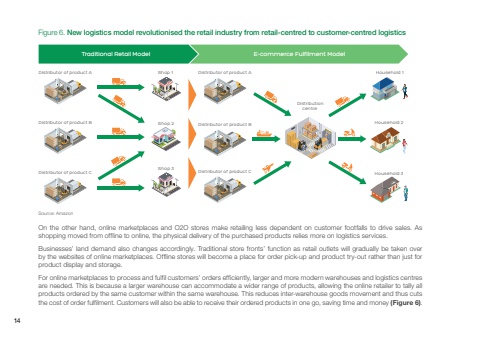
Figure 6. New logistics model revolutionised the retail industry from retail-centred to customer-centred logistics Traditional Retail Model E-commerce Fulfilment ModelDistributor of product A Shop 1 Shop 2Shop 3Distributor of product BDistributor of product CDistributor of product ADistributioncentre Distributor of product BDistributor of product CHousehold 1Household 2Household 3Source: AmazonOn the other hand, online marketplaces and O2O stores make retailing less dependent on customer footfalls to drive sales. As shopping moved from offline to online, the physical delivery of the purchased products relies more on logistics services.Businesses’ land demand also changes accordingly. Traditional store fronts’ function as retail outlets will gradually be taken over by the websites of online marketplaces. Offline stores will become a place for order pick-up and product try-out rather than just for product display and storage.For online marketplaces to process and fulfil customers’ orders efficiently, larger and more modern warehouses and logistics centres are needed. This is because a larger warehouse can accommodate a wider range of products, allowing the online retailer to tally all products ordered by the same customer within the same warehouse. This reduces inter-warehouse goods movement and thus cuts the cost of order fulfilment. Customers will also be able to receive their ordered products in one go, saving time and money (Figure 6). 14


